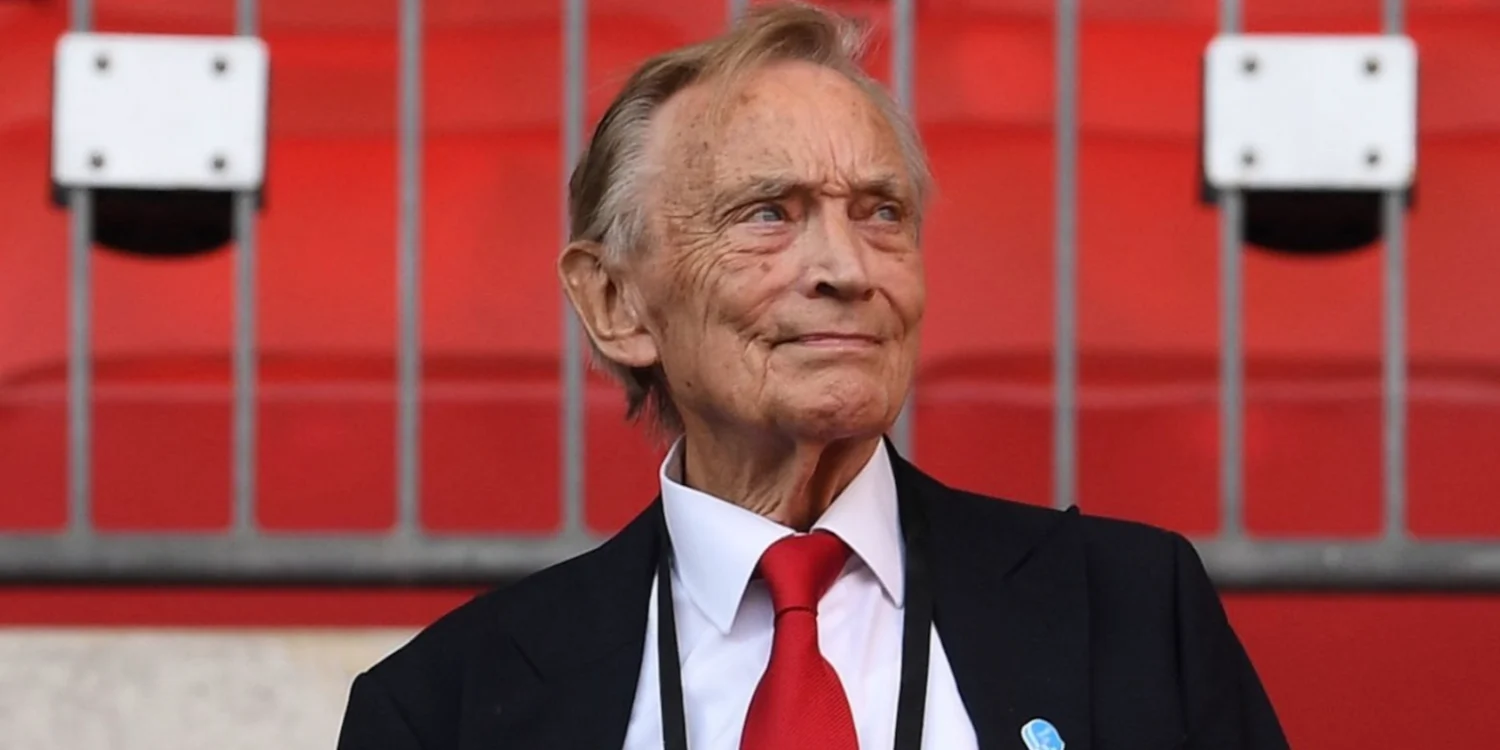
In 2012, journalist Nick Ames, then working for Arsenal, interviewed Ken Friar for an Arseblog Anthology called ‘So Paddy Got Up’.
In light of today’s very sad news of Mr Friar’s passing, we felt it apt to revisit that conversation as it appeared then.
___
The door is slightly ajar when I knock, as it so often is. Ken Friar OBE must have looked out of his office window, or perhaps even walked out onto his balcony overlooking Drayton Park, hundreds of times – surveying the sweeping, poignant panorama of the new Highbury Square development that these days greets his every sideways glance. Now, though, he’s facing squarely the other way and watching the screen of his Mac. It’s August, a particularly busy month in modern-day football, and the man still regarded by all and sundry as ‘Mr Friar’ shows absolutely no sign of letting up.
Almost to the day, this is the start of his 62nd year on Arsenal’s permanent staff. when you add another five or so as a temporary employee, he’s been a cog – of every size imaginable – in the Arsenal wheel for comfortably more than half of the club’s 125-year existence. Nobody has embodied the Gunners’ tradition, and its concurrent moving with the times, as adeptly or as selflessly even if, as he puts it with characteristic self-deprecating humour, “I’m still looking for a regular job!”
If the club’s rate of change during the first half-century of his employment could be described as stately, the last decade’s developments have been positively supersonic; it’s rarely been easy and has, as he tells me, often been plain exhausting. The warmth and wit remain, though, as does the twinkle in his eye as he recounts just some of a wealth of Arsenal experiences that will, surely, never be matched.
The beginning seems a very long time ago now, but can we start there? The story of how your involvement with Arsenal began is well-told, but remarkable, and bears repeating.
It’s honestly not a story I’m proud of, just one of those things than happened and I suppose you can’t alter history. I was a young boy and, as boys did then, we were playing football with a tennis ball outside the stadium on Avenell Road. The ball rolled away, and I ran after it as it disappeared underneath a big car. I scrambled under it, trying to rescue the ball, when a voice boomed out: “Boy, what are you doing?” I was scared to death! It turned out to be George Allison, the manager at the time. For some reason, he then told me to come back the following day. Why I obeyed him, I have no idea even now – it would have been easier to run away, and that would have been the end of it. But I returned as directed, and that’s how it all started.
So you went back – and then…
I went back and saw him – he introduced me to the box-office manager of the time and I then started as managing director! No, I began on half a crown a week running messages from the front door to the box office on a match-day. I was at Highbury County, a local grammar school, so this was something extra. But believe me, I still have no idea what made me come back.
But message boy to managing director is still an incredible leap. How did the progression work from there?
When the time to leave school arrived I had various things on the table. I wanted to be a stockbroker, and there was a position with a firm that I was really keen on taking. Five years had passed since I first started working at Arsenal, and the Club had been onto my family saying they’d like me to come and work full-time. My parents agreed, but I wasn’t keen because the salary I’d been offered at the stockbrokers’ office was twice as high – another £1.50 a week – as I’d get at Arsenal. Eventually they won, and I started here as a full-time employee in 1950, on £78 a year. From there, I worked through all kinds of departments. The business was very different then, remember – even when we were still over at Highbury in the early 2000’s, we only had one hundred and nine staff. That’s nearly quadrupled now.
From then, your rise was – in its understated way – meteoric…
Well, it was steady. I first became a bit more involved at boardroom level in 1965 – the club secretary was the big job back then and I was made his assistant. I moved up to become secretary in 1973; then became managing director ten years later. I stayed in that position until a time when I very much thought I’d be playing golf, and ended up deeply involved with Danny Fiszman and the move to Emirates, as you know.
Does the growth you spoke of just now astonish you?
I sometimes sit back, yes, and think of the way the club has changed and evolved. But remember, Nick, you’ve grown up in a period when everything is there. Back then we had no photocopiers, for example. Any reports had to be, typed and if there were twelve copies the girl had to do each one three times with carbon papers. I would produce reports and it would take me perhaps a day to do a report I could now write in five minutes.
Another example for you – tickets. Every ticket was produced by a printing company. They’d arrive in books and then had to be checked physically against the seating plan. Then you’d sell them over the counter and people would queue to buy them from the front entrance in Avenell Road up the hill, down the hill, right along to the tube station – thousands upon thousands of people, when it was a big game. We did all that on very few staff, but now it’s unfathomable to people.
And that’s just part of it – then there were the other areas of the business. Players used to get one-year contracts, there was a fixed salary and every year you’d renew all of the contacts in one day! We didn’t have massive numbers of shareholders or much of a commercial operation – instead we had lotteries that made us a £1000 a week and that felt like a fortune. We eventually had the highest shirt sponsorship deal around, with JVC, for over £100,000 a year and that was a big thing in its day. The scale of things has changed immeasurably.
With that, business practices themselves have moved on. Is it less about the bonhomie now?
It always has been, and still is, very cordial, but you have to remember that, although the bonhomie you mention was always there, the Club was still run like a business. The likes of Sir Samuel Hill-Wood and Sir Bracewell-Smith were both big businesspeople; Denis Hill-Wood was a senior partner in a stockbroking firm; Peter Hill-Wood was vice-chairman of a bank; Sir Chips Keswick was chairman of one. So it’s not been all “What’s next old chap?” – far from it. Once that door shuts it’s very much a business affair. In the boardroom it’s always been “Chairman” and “Sir” even if we’re on first-name terms, and are very good friends, outside it.
I count twenty major trophies in the cabinet since you started here. It’s such a broad question, but have any been more satisfying than others?
It’s hard to talk about any in particular; there have been so many events, memories and successes. I suppose one had to be the 1970/71 ‘double’ because we’d not won anything since 1953 – we’d endured seventeen years with nothing and suddenly started to win things. That was enormous and such a great satisfaction. There was also 1989 at Anfield of course. But tomorrow’s match is always the most important – that’s a maxim I always stand by.
Seventeen years with nothing perhaps puts the current run into perspective. But it leads me to ask you whether there have ever been any particularly dark periods in the years here – times when you thought the outlook was bleak.
There have certainly been times where you think the light’s been switched off, yes. But, honestly, it’s always been a great place to work and it’s the sort of job you wouldn’t be able to do unless you absolutely loved it. It’s more than a nine-to-five – the demands can be huge. I remember we’d be working over eighty hours a week regularly, for nearly six years, when we were working on the new stadium. I remember Danny once asking: “Do you feel tired?”
I said, “I do, a little bit,” and he then told me we’d worked eighty-seven hours that week. So that, in particular, was a very challenging time.
We were starting meetings at lawyers’ offices at 8am and I’d sometimes put my key in my lock back home at six o’clock the following morning. My son was living with us at the time as his house was being decorated – one morning I gingerly put the key in the door so as not to wake anybody. He came down the stairs and asked: “What time do you call this?!”
It was exactly what I’d been saying to him all his life.
That’s astonishing…
Well, for me it’s been a privilege. I’ve been so lucky to be involved with a club like this. We’ve worked as a team, we’ve had a great unit off the pitch and it’s always been ‘we’ rather than ‘me’.
The ‘we’ includes countless memorable characters from down the years, of course – does anyone in particular spring to mind?
I remember an old guy that worked in the ticket office when I first started – somebody came in and said they’d like to buy two seats for the weekend and asked if there would be a post in front of the seats. The chap said sternly: “Sir, I would remind you that our stand is supported by voluntary contribution only!” There were so many characters like that that maybe you wouldn’t get today. Then there were people like Denis Hill-Wood, Peter’s father – he was a great personality and loved by everyone, a real part of the Club’s fabric. And there are the ex-players, too, those who keep coming back and being a part of that we do. We still see the 1970/71 guys on a regular basis for example, and others from down the years too. Arthur Shaw is now 84 and he still comes in regularly. That affinity, that love, really counts for something.
And then, of course, there was Danny…
A phenomenon. What he did was phenomenal. He gave up so much, and probably lost a lot of money personally, in devoting the same eighty-odd hours a week – bearing in mind he had quite a big business to run too. He was utterly devoted to the Club, loved it – he’d wear the same red socks to every match through superstition, and we went to every game together home and away. He was a great, great character and a lovely, lovely man.
What makes Arsenal, the club of which you are such an enduring symbol, differ from others?
It’s the people that make the Club. The fans make it, the manager makes it and all the people that work for it make it. We have a set of values that I think are treasured, and we should never lose sight of those values – they were laid in place some eighty or ninety years ago by the Hill-Wood family and have been perpetuated ever since. I suppose if I’m to take credit for anything it’s for playing a part in continuing those traditions. Tradition doesn’t pay the wages but it’s a very important part of the structure, the fabric, of the Club.
Here’s an example. In 1939, players going off to the war were granted bonuses of £500 – a big thing back then. These bonuses were to be loaned back to the club at two-percent, so actually they never got the money. That came to light in the early 1980’s – the chairman found out and I was told to go back and find as many of these ex-players as we could. We then compounded that money and paid them some forty years on. That’s one real-life instance of the values we seek to live by.
The number of managers you’ve worked with here is in double figures, but you and Arsène have been particularly close…
It’s been a great time. He’s good at everything, one of those people you wish you hated! We were once in a meeting with people of four or five nationalities and he just kept changing languages effortlessly. Once or twice he’s shaken me – we might have a relatively obscure player recommended and he’d reel off the chap’s full professional and personal details off the top of his head. We were in Spain recently and he knew twenty of the players on the teamsheet, everything about them. He has a phenomenal football brain and can discuss any other subject you like with remarkable aplomb. I’ve travelled all over the place with him and he’s never lost his temper with anyone! It goes without saying that we’ve been so lucky to have him, and the day he decides to leave us will certainly be one of the saddest days.
On the other side of this corridor, it’s possible to look out onto the bridge that was named after you last year. Could you ever have imagined it?
It’s a bit embarrassing; I’ll have to catch the people responsible! We’d planned what we’d do to commemorate Danny, then the meeting was stopped and an addendum announced that a decision had been made to name the second bridge after me. I don’t even remember what I said at the opening ceremony – but I think it was along the lines of “when I started I thought the only thing they’d ever name after me was a coat-hanger.” Needless to say, someone gave me one of my very own with my name on it the other day! But it’s incredibly flattering to have a bridge named after me – now I just need planning permission for a toll at either end of it!
And as you cross that bridge daily, walking between Highbury House and the stadium, do you feel that you have as much energy as ever?
Well, I’ve cut back now; it’s just sixty hours a week! No, I’m still here every morning before 8 – I try not to stay into the evening as the pressure isn’t there to do so. But look, I work because I love the place and the people. I still get a great kick out of it, and am probably the luckiest guy alive to still be doing what I’ve always loved to do.
__
The interview reaches its natural conclusion, we say our goodbyes and instantly, after shutting the office door on my way out, I hear Mr Friar returning one of the calls he’s evidently missed during our conversation. Six hours of the working day still remain; not a second will be wasted, because not one ever has been.
The landscape upon which his labour of love sits may have changed forever, but a man whose term of service extends well beyond the combined ages of Theo Walcott, Jack Wilshere and Alex Oxlade-Chamberlain is not planning to wind down any time soon.