For anyone who feels like they’re living in 1984, you’re not alone.
The following has nothing to do with Flock cameras, the news, or anything else that would make the late George Orwell turn in his grave — although it’s worth noting that no one had these ideas about the 24-team College Football Playoff.
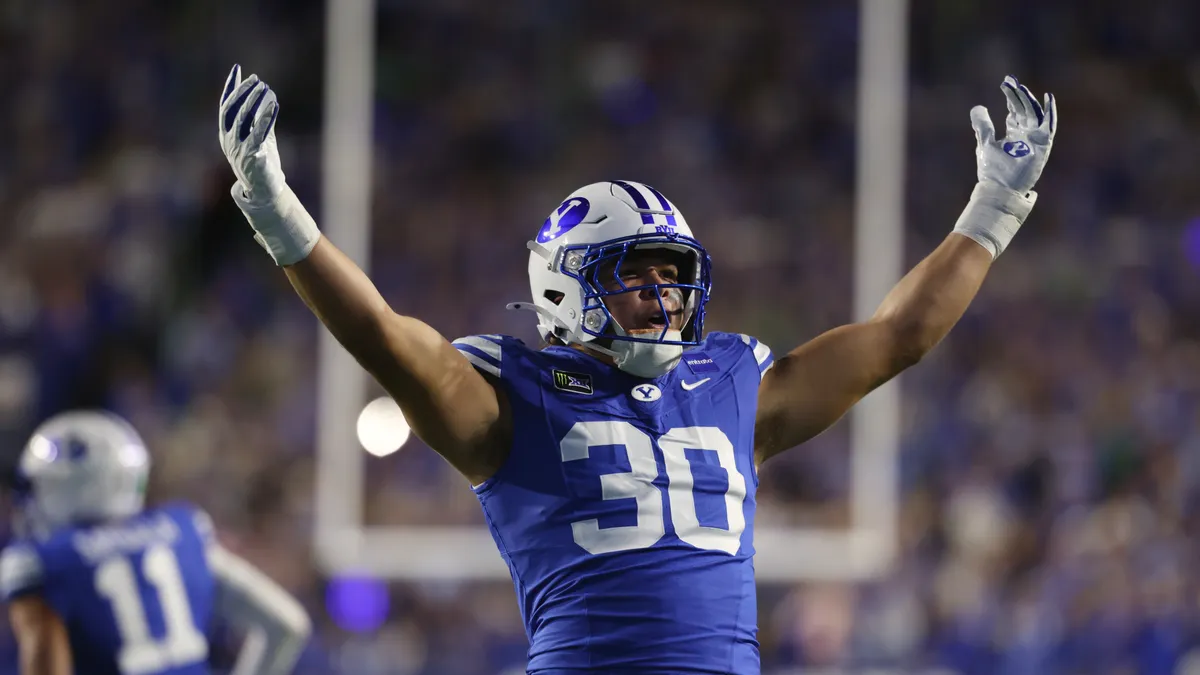
For our purposes here, the nod to 1984 comes from eighth-ranked BYU beating No. 2 Notre Dame 28-24 on Saturday. Their win over the Fighting Irish is the Cougars’ most significant win in 42 years, as BYU has claimed the most improbable national championship in modern college football.
The 1984 Cougars remain as the last team from an outsider conference to win a national title. Labels were less official during this era, prior to the Playoff, Bowl Championship Series, or Bowl Alliance.
Despite this, it was clearly understood that the Western Athletic Conference was not meant to compete for the crown that we know today as the power conferences. Just ask the 1975 Arizona Sun Devils.
However, a 20-14 victory over third-ranked Pitt to open the season sent BYU on a path lit by the right stars. As the Cougars racked up win after win week after week, with quarterback Robbie Bosco putting up some of the nation’s most impressive passing stats, other teams that should have been in contention for championships kept losing.
When BYU ended a perfect season with a loss to Michigan in the Holiday Bowl, only Washington was left with less than two spots on the record.
BYU’s victory over Notre Dame in the stadium named after LaVell Edwards, the coach who led the Cougars to the title, is the program’s most significant victory since the 1984 comeback at Pitt.
The ending wasn’t without controversy: BYU cornerback Evan Johnson and Notre Dame receiver Jaden Greathouse shook hands on CJ Carr’s final pass attempt. Physicality should have the Irish faithful buzzing with pass interference as long as Notre Dame stays in the playoff picture.
Nevertheless, BYU’s last defensive stand to preserve the victory brought about as much chaos as the entire 1984 campaign in 12 hours, putting a fitting cap on Saturday.
October 17, 2026 should go down as one of the wildest days in recent college football history. It started with an undefeated team from Indiana State losing on their last pass attempt and effectively ended the same way.
Defending national champion and fifth-ranked Indiana’s 19-14 home loss to Ohio State snapped the Hoosiers’ 22-game winning streak. The margin couldn’t have been narrower, as Josh Hoover’s fourth straight toss to Nick Marsh would have scored the go-ahead touchdown — if the throw hadn’t gone wide and sent Marsh out of bounds.
FOX’s production crew deserves a helmet sticker for capturing the stunned looks on Marsh’s face after canceling his palm. The Hoosiers receiver’s expression perfectly encapsulated the shock that reverberated through college football all day.
Indiana was 1 of 5 top 10 teams to lose on Saturday. Both the Hoosiers and their in-state counterpart, the Fighting Irish, were ranked in the top 10 despite losses to No. 1 Georgia and No. 7 Texas, each falling to unranked Auburn and Florida by one goal.
Sixth-ranked Alabama dominated in a 26-10 rout of No. 14 Tennessee. And while No. 3 Miami first received the news of being the top-ranked team in college football in December 2002, the Hurricanes struggled to pull off an overtime win over Florida State.
Miami is now one of a rapidly shrinking club of teams still undefeated in this tumultuous season. It’s a club that also includes tough Big Ten contender UCLA after a 17-7 win over Wisconsin; James Madison, a program previously coached by current UCLA coach Bob Chesney; and teams from the Big 12 Conference.
The Big 12 of 2026 is not the WAC of 1984. However, there is a similar, implicit understanding that the Big 12 is not meant to compete for national championships, as is the case with the Big Ten or the SEC.
That’s evident two years after the 12-team playoff, only the league’s automatic bid to the tournament advances.
Behind BYU’s signature win and with the anarchy taking place elsewhere in the sport, the entire Big 12 benefits the Cougars.