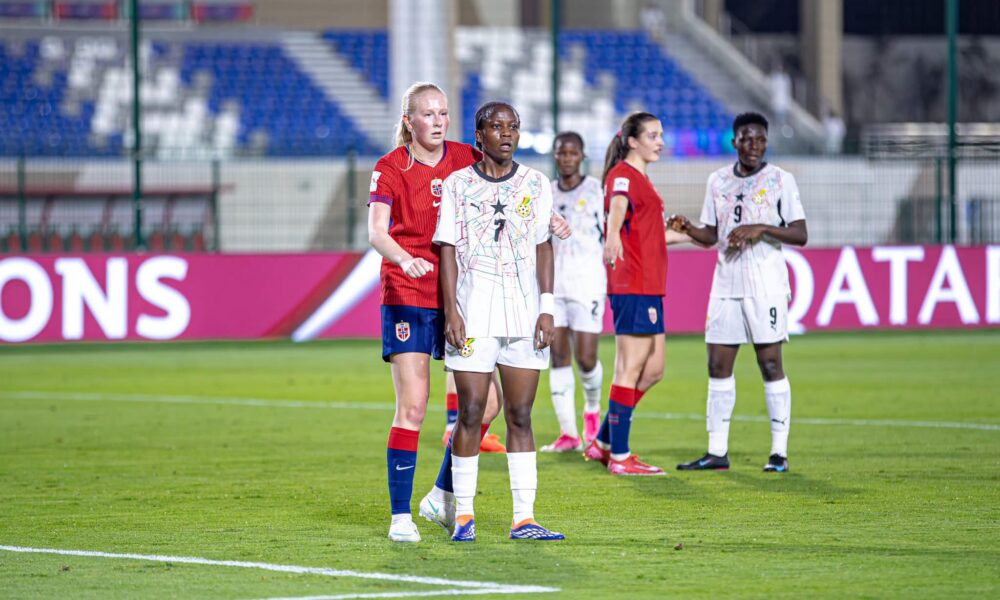
Ghana’s Black Girls team will return to the global stage for the first time since 2018, carrying the weight of an impressive history and the ambition to make up for a long absence, when they kick off their 7th FIFA U-17 World Cup campaign against Norway on 18 October.
Head coach Joe Nana Adarkwa has guided Ghana to qualification for Morocco 2026, defeating Togo, Liberia and Senegal to secure their place among the world’s top youth women’s teams. Their Group C opener against Norway will be played at the Mohammed VI Football Complex in Rabat, where all three of Ghana’s group stage matches will be played.
Ghana will face Brazil on October 21 before finishing the group stage with Canada on October 24. The challenge is significant, but the Black Girls will take heart from a history that includes a bronze medal and three quarter-final appearances.
Their return also presents an opportunity to restore Ghana’s reputation in a competition where the country has previously shown its ability to compete with the strongest teams in women’s youth football.
A journey that began in 2008
Ghana made their debut under coach Abraham Allotey at the inaugural FIFA U-17 Women’s World Cup in New Zealand in 2008.
Although the Black Girls collected four points from three group games, they failed to advance to the playoffs. They opened with a 1-1 draw against North Korea before losing 3-2 to Germany.
A 1-0 win over Costa Rica in their final group game was not enough to secure a place in the next round, bringing their maiden campaign to an early end.
Despite the disappointment, the tournament marked Ghana’s entry into emerging global competition and laid the foundation for future performances.
2010: Another disappointment in the group stage
Ghana returned for the 2010 edition in Trinidad and Tobago, hoping to improve on their debut performance. However, the team endured another difficult campaign and finished the group stage with three points.
The Black Girls lost their opening match to Canada but responded with a win over Brazil to revive their promotion hopes.
Those hopes were eventually dashed by defeat to the Republic of Ireland, and Ghana failed to qualify for the knockout stages of the tournament for the second time in a row.
Early speeches will soon open a more memorable page in the country’s history.
2012: Ghana’s historic bronze medal
The tournament held in Azerbaijan in 2012 remains a landmark in the history of the Black Girls World Cup.
Under Mas-Ud Didi Dramani, Ghana recovered from their opening defeat to Germany with wins over Uruguay and China to progress to the group stage.
Their progress continued in the quarter-finals, where Sherifatu Sumaila scored the decisive goal in a 1-0 win over Japan to send Ghana into the last four.
The Black Girls then missed out on a place in the finals, losing to France in the semi-finals. They responded impressively in the play-off for third place and beat Germany to claim the bronze medal.
The achievement remains Ghana’s best-ever finish at the FIFA U-17 Women’s World Cup and placed the team among the tournament’s standout performers.
2014: Quarter-final appearance on penalties
Ghana carried its growing reputation into the 2014 edition in Costa Rica, with Evans Adotey leading the team.
“Black Girls” finished first in their group for the first time in the history of the World Cup. They opened with a 2-0 win over Germany before beating North Korea 1-0 to secure their place in the quarter-finals.
A 2-1 loss to Canada in the final group game did not prevent Ghana from advancing as group winners.
Their quarter-final encounter against Italy was more closely fought, with neither side able to settle the tie in regulation time. The match went to a penalty shoot-out where Italy won to end Ghana’s campaign.
Although the Black Girls missed out on another semi-final appearance, topping their group was a significant achievement.
2016: North Korea ends Ghana’s run
Adotey maintained his position at the 2016 tournament in Jordan, where Ghana again crashed out of the group stage.
The campaign began with a heavy 5–0 loss to Japan, but the Black Girls bounced back with victories over the USA and Paraguay, winning 2–1 and 1–0 respectively.
These results advanced to the 1/4 finals by setting up a meeting with North Korea.
Ghana’s hopes of reaching the semi-finals were dashed with a 2-1 defeat to advance to their second straight quarter-final.
Despite this, the team established itself as a competitive force at the youth level and set an example of progressing through the group stage.
2018: Mukarama Abdulai leads Ghana’s golden run
Uruguay 2018 produced one of the most memorable individual performances in the competition’s history, with Mukarama Abdulai the tournament’s top scorer.
Under coach Evans Adotey’s successor, Bashir Hayford, Ghana had a flawless campaign in the group stage, winning all three matches and picking up nine points.
Mukarama scored a hat-trick in a 5-0 win over Uruguay and scored again in a 3-1 win against Finland. He then scored twice in Ghana’s 2-0 win over New Zealand in the group stages.
The Black Girls entered the quarterfinals with confidence, but were held by Mexico in a contest that went to extra time and eventually a penalty shootout. Despite their impressive performances in the group stage, Ghana were defeated in the shootout, ending their campaign.
As the tournament’s top scorer, Mukarama became the first African player to achieve success at the FIFA U-17 Women’s World Cup. His exploits remain a highlight of Ghanaian history in the competition.
The quarter-final loss was particularly painful as Ghana had won every group match and could make another deep run.
Years away from the global stage
Since their last appearance in 2018, Black Girls have been out of the competition for a long time.
Ghana failed to qualify for the 2022 tournament after losing on penalties to Morocco. The country later faced disciplinary action for age fraud, which led to its absence from subsequent editions.
The long hiatus has meant that a new generation of players will have to carry forward the legacy set by the teams of 2012, 2014, 2016 and 2018.
For Adarkwa and his team, qualification for Morocco 2026 is more than a return to competition. This is an opportunity to rebuild Ghana on the global stage and create a new chapter in the history of Black Girls.
Adarkwa faces a crucial challenge in Morocco
Adarkwa had a successful performance in the African qualifiers, ensuring Ghana’s qualification, beating Togo, Liberia and Senegal to secure the team’s place in the tournament.
Now with Norway, Brazil and Canada standing between Ghana and a place in the play-offs, the head coach has the task of turning this qualification success into performances against international opposition.
The Black Girls’ preparations in Morocco include friendlies against China and Kenya. After losing 3-0 to China, Ghana responded with a 2-1 comeback win over Kenya, captain Sadiatu Wahab converting a penalty before Priscilla Mensah scored the winner.
While the challenges that await Ghana in Group C will require consistency, defensive discipline and clinical finishing, the result is encouraging ahead of the tournament.
Ghana Group C games
Sunday, October 18: Ghana vs Norway – 18:00 GMT
Wednesday, October 21: Ghana vs Brazil – 18:00 GMT
Saturday, October 24: Ghana vs Canada – 15:00 GMT
All three matches will be played at Mohammed VI Football Complex in Rabat.
Ghana’s record at the tournament provides both inspiration and anticipation. The 2012 bronze medal remains a high point, while quarter-final appearances in 2014, 2016 and 2018 demonstrate the team’s ability to progress beyond the group stage.
As the Black Girls prepare to face Norway in their opening match, the immediate aim will be to start strong and put themselves in a good position to advance.
Years away from the global stage, the 2026 tournament offers Ghana a chance to build on its proud history and remind the world that the Black Girls are a team to watch in women’s youth football.