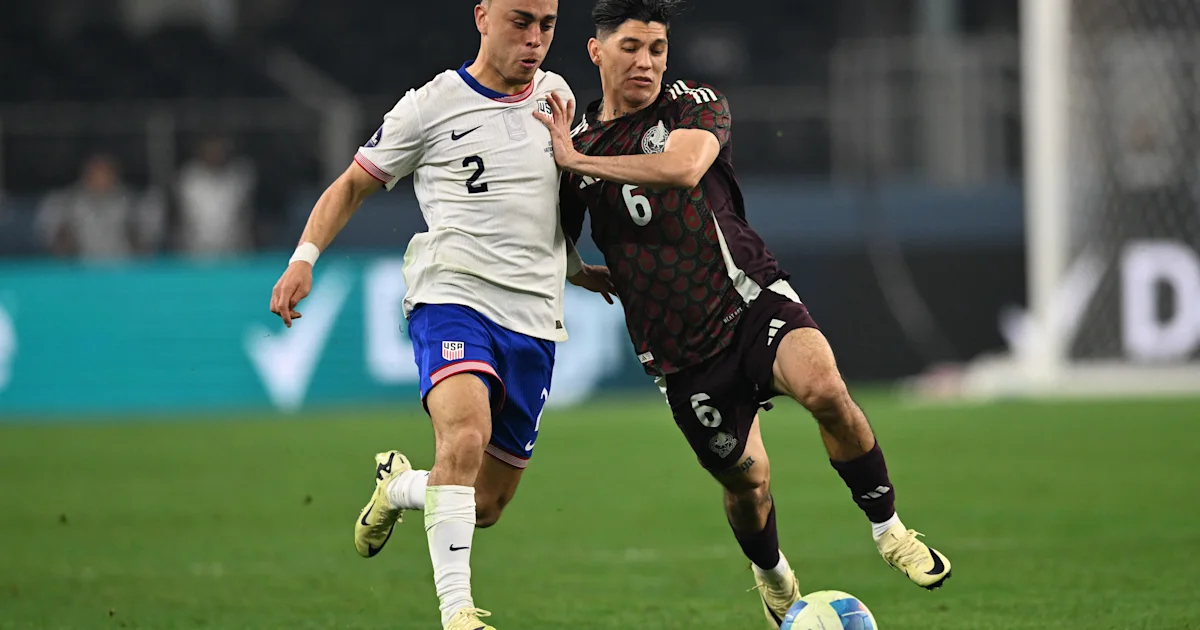
PHOENIX – The first two U.S. games of this international window followed the style and temperament expected of friendlies at the start of the four-year cycle leading up to the 2030 World Cup.
There were flaws and breakthroughs, lessons from youth, mass replacements and an acceptance that results don’t matter all that much.
Advertising
Tempers flared, blood boiled and benches emptied in the waning moments of the United States’ 4-2 win over Chile on Tuesday in St. Louis. He had become a friend in name only.
And maybe that was a good thing for the young Americans — those on the field and following the lead of their elders who took to the field to defend their teammates — because the tone and temperature of Saturday night’s next match against arch-rivals Mexico surpasses the heat outside State Farm Stadium in nearby Glendale, Arizona.
“We were just telling the young guys, you’re going to expect it [the end of the Chile game] When we play against Mexico and more,” said two-time World Cup winger Antonee Robinson, who has had his share of Mexican struggles. “We know how important this game is for both teams and it will be interesting to see the boys experience that in their first camp. I hope everyone accepts it, enjoys it and is ready to fight.”
A pro-Mexico crowd is expected for what is almost always a fierce and testing clash between traditional powers in the CONCACAF region. Although World Cup qualifiers do not carry the consequences of official competitions like the Gold Cup and the Nations League, pride remains high in the competition, which has risen to the list of major football struggles.
Advertising
“It feels really personal,” Robinson said. “Nobody thinks it’s friendship.”
Sergiño Dest is helping the USMNT’s young players prepare for the intensity of Saturday’s competitive match against Mexico.
(USSF via Stephen Nadler/ISI Photos/Getty Images)
Robinson and teammate Sergiño Dest spoke to reporters in the shade tape at a training ground exposed to the morning sun on Thursday. It was the perfect setting for the metaphorical buzz the Americans have come to expect from the first rumble against El Tri since the July 2025 Gold Cup final in Houston. Mexico has won the last two meetings following the United States’ seven-game unbeaten streak in the rivalry that began 92 years ago.
“These games are the real culture and the real passion of soccer,” said another veteran of the Mexican controversy, Dest. “It’s always amazing to see the competition between teams in general, and this is one of them. … Sometimes there will be battles, sometimes there won’t be. But we’re playing at home, so we have to show our passion for them as well … They can be so aggressive against us, [but] we have a big brotherhood.”
Advertising
Many of the young U.S. players participating in their first senior camp have faced Mexico in age-appropriate competitions, but this will be their first taste at the highest level.
“It can be frustrating for players who are in one of their first big games,” said Dest. “It’s normal, but the only thing I can help them with is to stay calm and believe in all the abilities they’ve been training for all these years and show what you’ve got, because that’s what we need.”

Two-time World Cup winger Antonee Robinson on what the newcomers should expect from Mexico: “No one thinks it’s a friendly.”
(Taylor Banner/USSF via Getty Images)
In the first two matches of the camp, USA coach Mauricio Pochettino threw the newcomers into the deep end of the pool. He made his debut last Saturday in Orlando’s 4-1 win over Peru and the other was christened against Chile. Only winger Cole Campbell, who is sidelined with an undisclosed injury, has yet to make his debut.
Advertising
7 new players appeared in both matches. 18-year-old forward Julian Hall, who scored in both, added an assist and faked a Dest pass that led to Sebastian Berhalter’s goal against Chile. 17-year-old winger Mathis Albert became the youngest goal scorer in US history with his latest goal on Tuesday.
Forward Kavan Sullivan, who just turned 17, ran down the flanks with speed, skill and zeal. Midfielder Brooklyn Raines, 21, was one of two U.S. players to play 90 minutes against Chile.
The four goalkeepers, led by World Cup starter Matt Freeze, played one and a half each.
Despite a strong influx of inexperienced players, the U.S. played with greater chemistry and rhythm than expected after less than a week of practice at the national training center near Atlanta.
Advertising
“I didn’t know how to go into this game with 12, 13 new players coming into camp and all very young,” Robinson said. “But it’s been great to see kids come and work hard and be humble and want to get to know everybody. And obviously to see their talent [shown] and the hard work they’ve put in, it’s been a very enjoyable camp so far.”
The camp – Pochettino’s first since the World Cup and the first since signing a new contract to lead the program at the 2030 competition – will continue until next Tuesday, when his side face another strong CONCACAF rival, Canada, in St Paul’s.
Advertising
Wins against Peru and Chile were impressive and Canada will be a test, but the Mexico matches will stand the test of time. With that in mind, Pochettino looks set to field a veteran-heavy squad, sprinkled with youngsters such as 19-year-old striker Justin Ellis, who scored early on his debut against Peru, and Sullivan, who started the first match and came on late in the second.
The Argentinian coach also showed his confidence in his youth and as a result threw several people into the fire in the desert. At the very least, he is likely to play a good portion of the match.
“Young players sometimes have to learn a little bit more,” said Dest. “Sometimes early in your career you get that amazing hunger and you’re not afraid to try things. It’s a great balance and they’re doing great so far.”