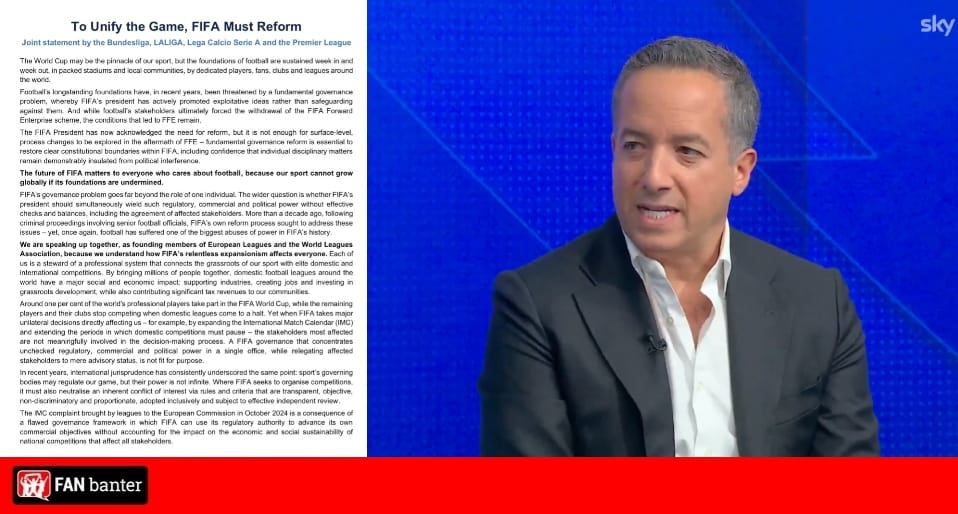
The Premier League, Bundesliga, La Liga and Serie A issued statements demanding reforms from FIFA and calling for a new governance structure.
At a time when President Infantino is trying to keep his job, Europe’s top four leagues are unhappy with his attempts to sell World Cup stakes to some of President Trump’s family, colleagues and friends.
Infantino faced widespread criticism two months ago, with UEFA first announcing a boycott of all FIFA events if football’s governing body did not withdraw plans to sell shares in the World Cup. CONCACAF and AFC also joined UEFA in not approving the proposal. South America’s CONMEBOL also wants more information from FIFA.
FIFA hit back at UEFA’s decision, issuing a statement denying it was “selling footballs” and then taking issue with “incorrect media reports” that “disrupted the consultation process”.
FIFA president Gianni Infantino abandons controversial World Cup investment plan
Kaveh Solhekol said on the show sky sports news This week: “It’s not just that that’s not what they’re happy with. There’s a lot of other reasons.
“But what’s really unsettling about these major European leagues, under Gianni Infantino, is that they feel they’ve been completely marginalized in terms of how the international fixture calendar is set up. They want more of a say.
“For example, the Club World Cup, they think it shouldn’t be expanded, it shouldn’t happen.
“They have actually gone to court to try to review this international calendar but they feel FIFA is not listening to them.”
BREAKING NEWS: The Premier League and three of European football’s other top leagues (Germany, Italy and Spain) will issue a joint statement tomorrow demanding governance reforms from FIFA as president Gianni Infantino attempts to keep his job 🚨 pic.twitter.com/INQsxaacSg
— Sky Sports News (@SkySportsNews) September 24, 2026
The statement is as follows: “The World Cup may be the pinnacle of our sport. But the foundations of football are sustained day in and day out by dedicated players, fans, clubs and leagues around the world in packed stadiums and local communities.
“In recent years, the long-term foundations of football have been threatened by fundamental governance issues, with FIFA presidents actively promoting exploitative ideas rather than guarding against them. While football stakeholders ultimately forced the withdrawal of the FIFA Forward Enterprise plan, the conditions that led to the FFE remain in place.
“The FIFA President has now acknowledged the need for reform, but exploring surface-level process changes following the FFE is not enough – fundamental governance reform is essential to restore clear constitutional boundaries within FIFA, including the belief that individual disciplinary matters remain clearly free of political interference.
“FIFA’s future is important to everyone who cares about football because our sport cannot grow globally if our foundations are undermined.
“The issues of FIFA’s governance go far beyond the role of one person. The broader question is whether the FIFA president should simultaneously exercise such regulatory, commercial and political powers without effective checks and balances, including the consent of affected stakeholders. FIFA’s own reform process sought to address these issues more than a decade ago, following criminal proceedings involving senior football officials – however, football has once again suffered one of the worst abuses of power in FIFA’s history.
“As founding members of the European Leagues and World Leagues Associations, we raise our voices together because we understand how FIFA’s ruthless expansionism affects everyone. Each of us is a steward of a professional system, connecting the grassroots of our sport with elite domestic and international competitions. By bringing millions of people together, domestic football leagues around the world have a significant social and economic impact: supporting industry, creating jobs and investing in grassroots development, while also contributing significant tax revenue to our communities.
“Approximately one percent of the world’s professional players participate in the FIFA World Cup, while the remaining players and their clubs stop playing when domestic leagues are suspended. However, when FIFA makes major unilateral decisions that directly impact us – for example, by expanding the International Match Calendar (IMC) and Extending the period during which domestic competitions must be suspended – with no real involvement of the most affected stakeholders in the decision-making process FIFA’s governance, which concentrates unfettered regulatory, commercial and political power in one office while relegating affected stakeholders to a mere advisory status, is not fit for purpose.
“In recent years, international jurisprudence has consistently emphasized the same point: sports governing bodies can regulate our games, but their powers are not unlimited. When FIFA seeks to organize competitions, it must also eliminate inherent conflicts of interest through rules and standards that are transparent, objective, non-discriminatory and proportionate, inclusive and subject to effective independent review.
“The IMC complaint lodged by the federations with the European Commission in October 2024 is the result of a flawed governance framework in which FIFA can use its regulatory powers to advance its own commercial objectives without taking into account the impact on the economic and social sustainability of national competitions that affects all stakeholders.
“1. Give affected stakeholders a real role in decision-making
“FIFA must establish a permanent body representing key stakeholders, including national associations, leagues, clubs and men’s and women’s football players. This new body must be fully informed of the new initiatives and play a meaningful role in FIFA’s decision-making process. In decisions involving matters such as fixtures, employment, competitions and football’s core assets, the consent of the stakeholder groups directly affected by the decisions must be obtained.
“2. Ensure decisions are based on evidence
“Any major FIFA proposal must start with clear rationales, supporting evidence and an independent assessment, published before any decision is made, covering players, clubs, leagues and supporters, and assessing the impact on all stakeholders and the development of football. A range of options should be carefully scrutinized and the final decision should be accompanied by a published explanation.
“3. Protect FIFA’s regulatory role from its commercial functions
“FIFA’s role as regulator and guardian of the football competition must protect its commercial functions as organizer of global competitions with strong institutional safeguards to safeguard trust, legitimacy and accountability. The appointments, budgets and powers of the ethics, financial oversight and electoral bodies must be truly independent of the FIFA executive and the presidency. These reforms will ensure that FIFA’s core competitive rights, including the World Cup, are trusted by all football communities.
“keep going
“At this critical moment for our sport, we encourage FIFA presidential candidates to endorse these principles and convene an independently chaired governance conference representing member associations and the wider football community within the first 100 days of the next president’s term, with a request for a public report within six months.
“All FIFA presidential candidates should publish their reform proposals, debate their content and abide by fair electoral rules. FIFA’s financial, legal, communications and marketing resources and Football Development Fund must remain strictly neutral and in no way create an electoral advantage for any candidate.
“We invite federations, national associations, leagues, clubs, players’ unions, supporters groups and public authorities from all continents to join this cause by supporting these principles.
“It is now time to decide not just who will lead FIFA, but how it will be led. The federations play a vital role in this process and we want to ensure that every federation’s voice is heard.
Football needs FIFA to be a strong institution. But strength must be matched by responsibility. FIFA’s authority can only come from sharing responsibilities, accepting oversight and earning trust.
“sign,
Mark Lentz, CEO
Bundesliga
Javier Tebas, President
LaLiga
Luigi DeSilvo, CEO
Italian Football League
Richard Masters, CEO
Premier League”