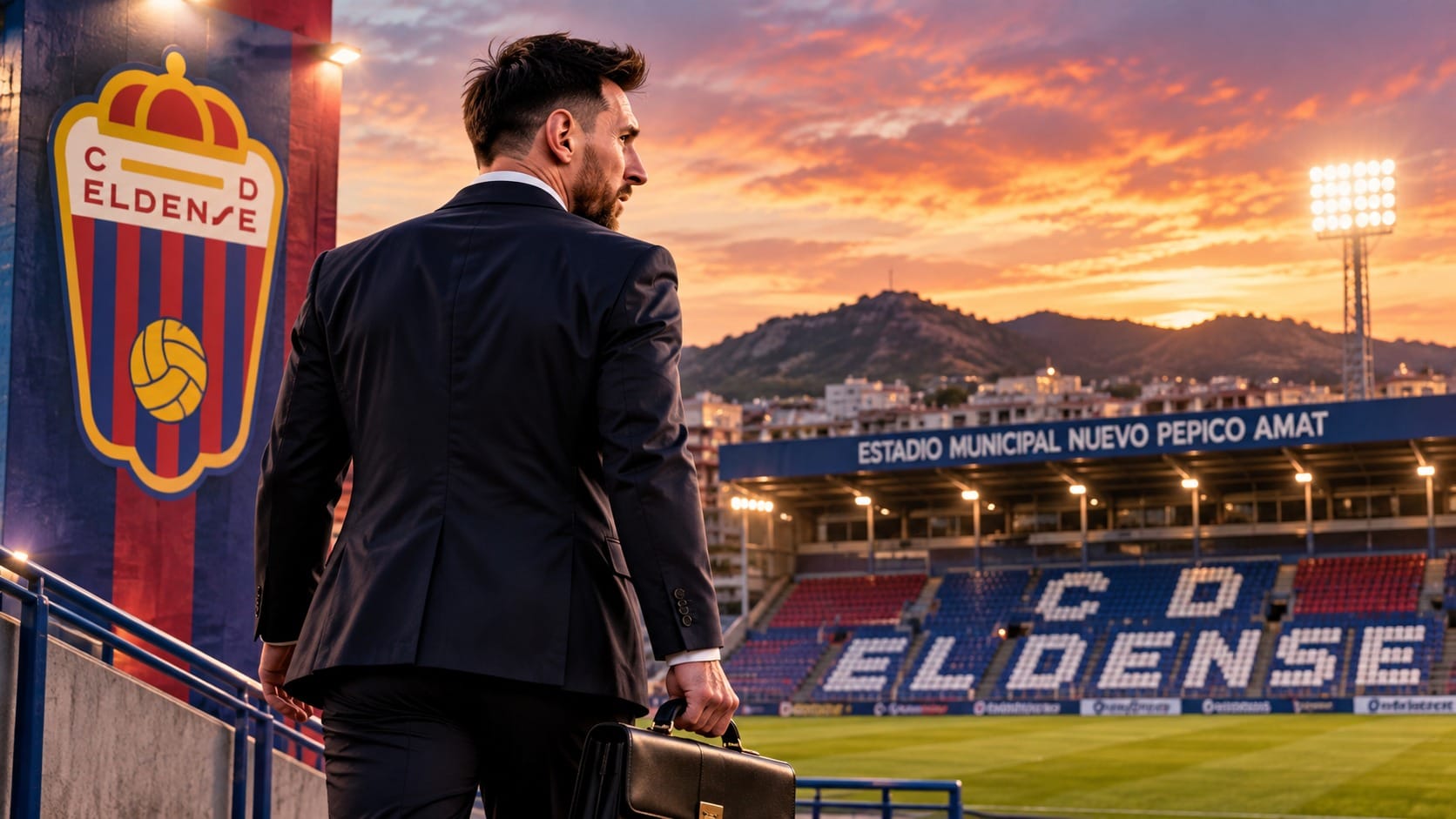
Lionel Messi has expanded his growing portfolio of football ownership after buying Spanish second division side CD Eldense in 2026, marking his second investment in Spanish football.
The eight-time Ballon d’Or winner, who went on to play for Inter Miami in Major League Soccer, took control of the Alicante-based club following an agreement reached in September. The transaction remains subject to regulatory approval from Spain’s Supreme Sports Council.
The move further strengthens Messi’s involvement in Spanish football outside of his storied playing career after he bought Catalan club UE Cornellà in April.
For Eldense, the arrival of one of football’s most recognizable figures represents a potentially transformative moment in the club’s history.
CD Eldense officially confirmed the takeover on October 1, announcing the start of what it described as a new chapter in the club’s more than 100-year history.
Eldense, founded in 1921, compete in Spain’s Segunda División, the country’s second tier, and is a significant step in Messi’s football ownership ambitions.
The club stated that the purchase will start a long-term project focused on sports, institutional and social development while preserving its historical identity and relationship with its supporters.
Messi’s first Spanish football investment came in April when he bought UE Cornellà, a Catalan club struggling in Spain’s fifth division.
Although the direct goals of the projects differ, the two investments put the Argentine superstar in an increasingly influential position in Spanish football.
While Cornellà offers an opportunity to develop a lower league club, Eldense offers Messi a place in professional football just one division below La Liga.
Can Messi save Eldense’s season?
Messi’s arrival comes at a difficult time for his new club.
Eldense are currently in 19th place in the 22-team Segunda División with just five points from their first seven matches.
With relegation already in danger, new ownership reach a crucial stage of the campaign.
However, Messi’s presence does not automatically guarantee an immediate financial turnaround or a major influx of players.
Spanish football operates under financial control and any long-term development requires careful planning, investment and recruitment.
The club’s stated ambition is to create greater stability and development, rather than simply relying on the hype created by a famous new owner.
Nevertheless, Messi’s global profile could bring increased international attention, commercial opportunities and renewed interest from fans around the world.
For a club founded more than a century ago, the challenge will be to translate that focus into sustained progress on and off the pitch.
Messi’s relationship with Spanish football dates back to his teenage years.
He moved from Argentina to Spain aged 13 before making his first-team debut for Barcelona in October 2004, aged just 17.
Over the following years, he became the defining player of Barcelona’s modern era, scoring 672 goals in 778 games.
His achievements include 10 La Liga titles and four UEFA Champions League trophies before leaving for Paris Saint-Germain in 2021.
After spending two seasons in France, Messi joined Inter Miami in 2023 and took his career to Major League Soccer.
His move to club ownership now provides another avenue for the Argentine to stay connected to football long after his playing days are over.
At 39, Messi continues to play at the highest level and is gradually building a portfolio that could shape his post-playing career.
Messi and Ronaldo: Football’s biggest rivals are turning away investors
Interestingly, Messi is not the only member of football’s biggest modern competition to be owned by a Spanish club.
Cristiano Ronaldo added football investment to his business interests by acquiring a 25% stake in Spanish club UD Almería in February 2026.
The two superstars have spent most of their careers battling it out for individual awards, including the Ballon d’Or, while dominating European football for more than a decade.
Both are now building relationships with Spanish clubs, albeit with different ownership arrangements.
Ronaldo’s investment in Almeria and Messi’s increased involvement with Eldense and Cornellà highlight how two of football’s most influential figures are preparing for life beyond their playing careers.
What’s next for CD Eldense?
The immediate priority for Eldense is their position in the Second Division.
Regulatory approval is still required to complete the takeover process, while the club also needs to address its difficult start to the season.
Messi’s name alone will attract attention, but the real measure of the purchase will be the club’s development in the coming years.
Could Eldense eventually become regular contenders for promotion to La Liga? This remains a long-term ambition, not an immediate expectation.
For now, one thing is certain: Lionel Messi’s influence on Spanish football continues to grow, even as his playing career enters the later stages.
The man who dazzled Barcelona fans for 17 years is starting a new page this time from the owner’s chair.