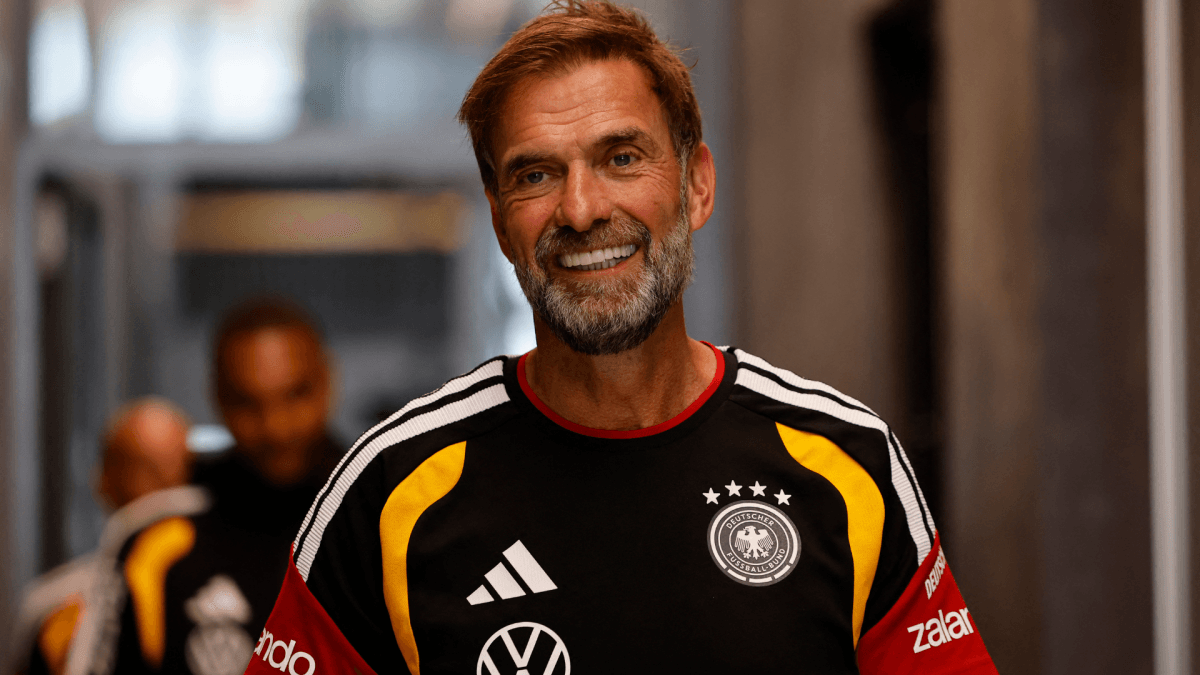
Since winning the championship in 2014, the German team has failed to reach the top 16 in three consecutive World Cups. Under the leadership of Jurgen Klopp, the German national team has officially entered a new era. And the former Liverpool boss to quit club football in 2024 As for the mental reset that came with running out of energy, he always felt it was just a matter of when, not if he would eventually take over the German national team. Klopp, who previously served as Red Bull’s global head of football, overseeing the entire international club network, has taken over and has begun reforms in his first international break in charge, assembling a 44-player squad for the UEFA Nations League, where they will face the Netherlands, Serbia and two games against Greece.
In his first game, Germany may have scored the first goal in a 1-1 draw with the Netherlands, but their possession and performance were at a disadvantage throughout the game, ultimately losing to the Netherlands by an expected score of 3 points. Coupled with Kai Havertz’s injury, this game showed just how daunting the task ahead is for Klopp. He may be a legendary coach, but fixing the German national team will require more than just Klopp showing up and immediately pushing the team to play beyond their capabilities, and this first game confirmed why he has called up such a large group of players.
It’s time for him to look at what he has in the team, but the fact that he even has to do that begs the bigger question: how did German football come to be this way. Playing young players is common in the Bundesliga, and while the Premier League is more attractive to young players, only eight of the 18 top-flight clubs have given more than 30% of their playing time to German players this season, with Werder Bremen, Hoffenheim, Hamburg and Bayer Leverkusen all falling below the 25% threshold. Apart from Leverkusen, these are the most productive academies in the history of German football, so you’d expect this to also result in more German players in their squads, similar to Stuttgart, who lead the way this season with a whopping 80.9% of their playing time going to German players.
Red Bull’s hopes for German football
RB Leipzig is one of the clubs in Germany that has seen an increase in the percentage of playing time, which is where we get back to the Klopp effect. One of the moves he made during his time at Red Bull was to hire David Wagner as the club’s academy director. Wagner’s arrival also brings about a shift towards developing more home-grown players given the shift in spending, which has seen leagues around the world target young players who previously would have gone to Leipzig.
Since Leipzig is the only top-flight club in the German region and is close enough to Berlin, Leipzig should have an advantage in this area. Wagner has spent a long time in the English youth system and admitted during a roundtable at RB Leipzig’s training ground that their youth development has surpassed that of Germany. There was a time when the facility was state-of-the-art but now it is the standard for top clubs in the Champions League and this is where the development process that Wagner is responsible for can come into play.
“They are completely focused on individual development programs in team training,” Wagner said of the English development system. “I think they don’t even have a league table before the U16s. They meet at the weekend, they play games, they like to win but no one cares about the table. The whole week is individual: what they have to do in the gym, on the pitch, in the treatment room. It all depends on the individual’s six-week cycle.”
“We have a lot of rules in German youth football that are dependent on adult football,” he continued. “For example, if a 15-year-old gets a second yellow card, he’s suspended for one game. If he’s suspended, how can he get better? He has to play to get better. Let him play! We have a lot of rules in Germany to keep the game fair, but this is youth football. They have to play against each other. There’s no problem playing against older players; it’s just a bigger challenge.”
Wagner makes sense because one of the most important things when you’re young is to get out there and play as much football as you can. If you’re doing well in your peer group, it’s time to move up a level and see how you fare. As an athlete there is always going to be a level down in play and individual planning and care for their development is crucial as no two players will develop at the same rate. These are the questions Wagner has posed to the German Football Association (DFB), which is also trying to figure out how to turn around the national team’s performance. Some of these changes are also possible given his relationship with Klopp.
More games are the goal
Germany has launched a new U21 competition which will increase the number of games for young players. Currently, Bundesliga 2 teams typically compete in the lower rungs of the German pyramid, and it’s not a system set up specifically for development like Premier League 2 or MLS Next Pro. Wagner mentioned that Leipzig Red Bull missed the Champions League last season by failing to participate in the UEFA Youth League, and participating in such a league will bring different results. RB Leipzig even created its own youth competition in the RBL Cup.
This was done under Wagner’s leadership to give players more opportunities to compete at a high level. These include the youth academies of Red Bull Salzburg, Paris FC and Utrecht, as well as the likes of Liverpool, Atletico Madrid, Porto and Mainz. This is a significant development and Wagner estimates that the RB Leipzig U19 team will play approximately 60% more games than last season. Of course, there is a balance to be struck between recovery and ensuring the burden on players is not too high, but it should come as no surprise that the way to improve football is to play more football.
Repetition is important when working with coaches to work on areas for improvement, and more games also means more opportunities to practice what they’ve been practicing at full speed, while also giving players more video of themselves performing to learn from. It’s not something that’s going to happen instantly and the academy won’t bear fruit overnight, but as Leipzig’s own model shifts away from just buying young players from abroad and improving them at the club, part of the solution is to focus domestically.
“We know Berlin breeds talent. Hamburg also has great talent,” Wagner said. “But as well as Berlin, this East German region is also a focus for us. My question is always: why aren’t more Berlin-born players coming through RB Leipzig? We have already started signing players from Berlin for our U19 squad, but this is an area we definitely need to exploit more effectively.”
Keep up with the Premier League
There are several reasons why tapping domestic talent is critical. In a world where finances have to be balanced and clubs have to sell before they can buy, RB Leipzig chief executive Marcel Schaefer admits this was a key factor in Jan Diomande’s move to Real Madrid. While you don’t want to deny a player a move to a club of this caliber, selling a player for around €140 million can avoid the need to move other members of the squad.
With the Premier League signing more young players, it is becoming more difficult for German clubs to continue to develop young players like before. The consequence of an unknown Belgian prospect now heading straight to Brighton rather than Frankfurt is the need to focus on home ground, which in turn helps the national team.
“They definitely have more economic power than we do in Germany. If you look at some of the newly promoted teams and how much they spend, that would never happen in Germany, even for Bayern Munich,” Schaefer said of the shift in Premier League power. “It’s a challenge but it’s still an opportunity for a club like us. We saw that last year when we sold players to Premier League teams. On the other hand, it’s really challenging because Premier League teams have changed their focus.”
“Five to seven years ago it was obvious that if a rising star emerged in Germany they would move to Bayer Leverkusen, Dortmund or Leipzig,” he continued. “Now, mid-table teams in the Premier League are trying to sign these players straight away. You have to find a good balance. We believe we are still one of the best clubs in Europe for young players to work and develop, but it is now more challenging.”
There is still a long way to go in combating spending growth, but Wagner’s proposals could help the Bundesliga and German football return to equal footing with other European leagues. Developing more top talent not only leads to more revenue, but also increases the depth of the team to compete on multiple fronts. Bayern Munich are an exception in the Bundesliga, but even they haven’t won the Champions League since 2020. If Leipzig’s attack pays off, they could also be back to challenge Bayern Munich for the Bundesliga title with their national team players under Jurgen Klopp.