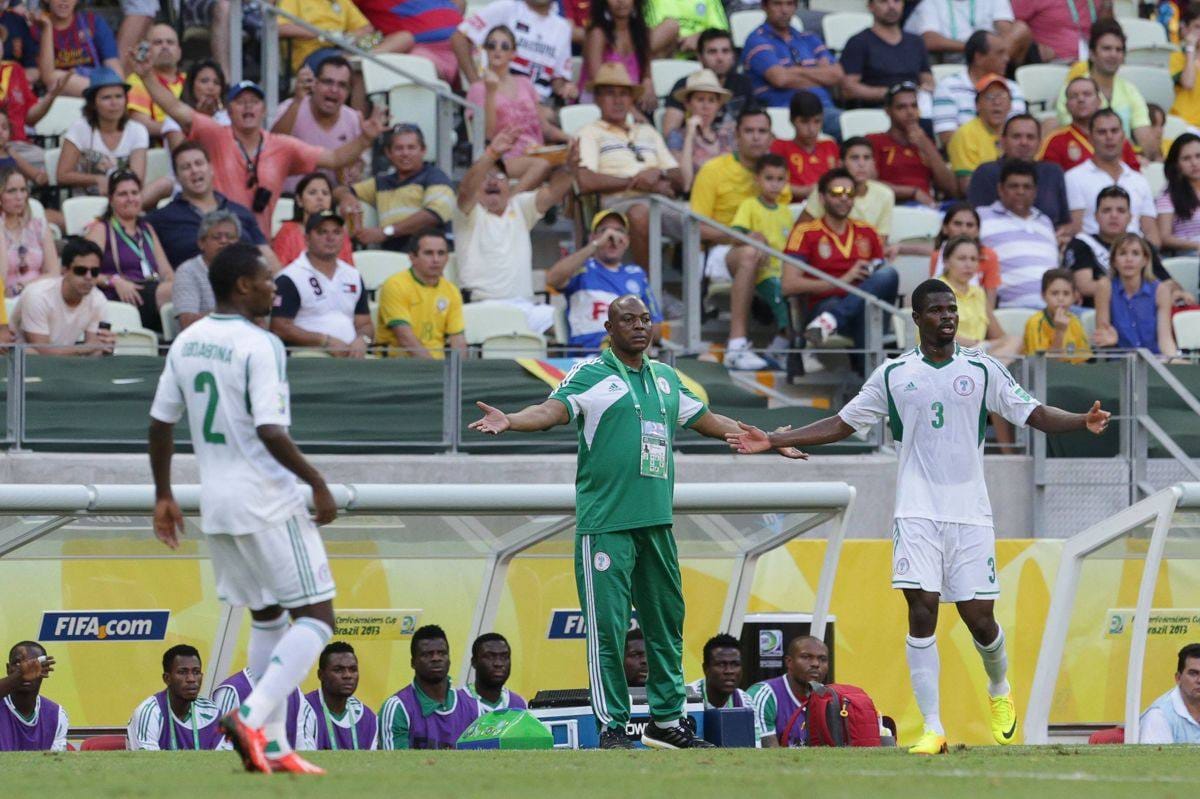
40 minutes into the 2013 Africa Cup of Nations final in Johannesburg, a blocked Victor Moses shot fell to Bazar Mba. He picked up the ball, took it past a defender and fired it home (Bleacher Report).
Burkina Faso never found an answer. When the whistle blew at Soccer City on February 10, Nigeria were crowned continental champions for the third time and first in 19 years. The man in the dugout, Stephen Keshi, had just joined Egypt’s Mahmoud Al Gohary as the only men to win the trophy as both player and coach (Al Jazeera).
He was 51 years old. He left less than three and a half years later.
Azare to Anderlecht
According to Daily Trust, Stephen Okechukwu Keshi was born on January 23, 1962 in Azare, Bauchi State. He started at ACB Lagos in 1979 and moved to New Nigeria Bank, Benin. His international debut was in 1981.
Abidjan was the first stop abroad in 1985 (Africanews). Belgium followed: Lokeren in 1986, then Anderlecht from 1987 to 1991 99 performed and scored a goal 18 goals. Then came Strasbourg, then more Belgian football, a spell in California and a final stop in Perlis, Malaysia. The National wrote that his move in the mid-1980s helped Nigerian players migrate to Europe (The National).
He won 64 shirt and scored nine goals (Sky Sports) and, as reported by the ICIR, a FIFA tribute commemorated him at his death as a centre-back who “took games by the neck and dictated matches from a position of influence as captain” (ICIR).
Tunisia, however. This was the peak. Emmanuel Amuneke scored twice against Zambia at Stade El Menzah on 10 April 1994, Ilyas Litana headed one back as the Eagles won 2-1 (Goal; The Guardian Nigeria). Daily Trust said that year, “a stingy Nigerian defence”. That summer, he captained the country to its first World Cup in the United States, a story told in our article on the Nigeria 1994 World Cup squad.
Togo, Mali and the long road home
The Togo case came in 2004. Against the odds, Keshi led the Falcons to the 2006 World Cup for the first time (Africanews). The reward was brutal. Togo appeared in the first round of the 2006 Nations Cup in Egypt and was kicked out. Otto Pfister took the team to Germany, as VOA reported at the time. He returned to Lomé briefly in 2007 and then worked in Mali in 2008. That ended in 2010 when a group stage exit at the Cup of Nations in Angola ended his tenure. Two jobs, two exits.
The NFF hired him in November 2011 (Al Jazeera). Many dismissed him as inexperienced, as Premium Times later recalled (Premium Times).
Johannesburg, Brazil and the bitter end
His squad for South Africa 2013 was a gamble. 19 Out of 23 players, he was the debutant of the tournament. Six were at home including Mba, Godfrey Oboabona and Ejike Uzoenyi (Channels Television). The full list and every squad from this run is in our Super Eagles AFCON 2013 squad guide.
This worked.
After the final, he spoke about building, not just winning: “When I came on board a year and a half ago, my dream was to make all Nigerians happy” (Al Jazeera). CAF named him the best coach of 2013 (Africanews).
Juwon Oshaniwa came off the bench in that final. He told Pulse Sports in March 2026: “The confidence he gave to all the local players ensured that whenever he called on us, we would always deliver” (Pulse Sports).
Then Brazil.
Nigeria reached the round of 16 at the 2014 World Cup and FIFA credits Keshi as the first African coach to go that far (FIFA). Al Jazeera added that he is the only African coach to have qualified two countries for the World Cup. France finished 2-0 in Brazil on 30 June 2014. “It’s been a good run and I’ve enjoyed every moment,” he tweeted. “I wanted to leave on a high for my country,” he told BBC Sport (The National).
He stayed. It turned sour. Nigeria failed to qualify for the 2015 Nations Cup and on 4 July 2015, the NFF terminated his contract once and for all, saying his actions lacked “the commitment required to achieve the objectives of the Federation” (TheCable).
| Period | Role | Emphasize |
|---|---|---|
| 1979-1985 | Player, ACB Lagos and New Nigeria Bank | International debut in 1981 |
| 1985-1998 | Player in Ivory Coast, Belgium, France, USA, Malaysia | 99 games in “Anderlecht”, 18 goals |
| 1981-1995 | Nigerian player and captain | 64 games, 9 goals, AFCON 1994 winner |
| 2004-2006, 2007 | Head coach of Togo | Togo qualified for the World Cup in 2006 |
| 2008-2010 | Head coach of Mali | He was sacked after his exit from the AFCON 2010 group |
| 2011-2015 | Head coach of Nigeria | AFCON 2013 winner, 2014 World Cup Round of 16 |
Benin City, June 2016
Grief came first. His wife Keith Keshi died of cancer in December 2015 and his brother Emmanuel Ado Keshi said he has been mourning him ever since and had to return to the United States on Wednesday morning June 8, 2016 after suffering a heart attack in Benin City. sports).
NFF president Amaju Pinnick put it simply: “It’s devastating. We’ve lost a superhero.” Ghana FA president Kwesi Nyantakyi called him “a great man and a noble soul” (National).
“Shocked and saddened by the devastating loss of Big Boss, a father and coach who gave so many of us the chance to live our dreams.” Ogenyi Onazi, via Al Jazeera
Tributes crossed borders. Sunday Oliseh, his teammate in Tunisia, wrote: “Today we lost an iconic hero.” FIFA president Gianni Infantino expressed his “deepest sympathy” (FIFA). From Zambia, the country he won the 1994 final, Kalusha Bwalya said: “I woke up to the sad news of the death of my brother Stephen Keshi” (SportsClub). He was buried in late July 2016 in Illah, Delta State where he was born. Former goalkeeper Peter Rufai called him “the great pillar on which Nigerian football rests” (Channels Television).
What Keshi means to Nigerian coaches
Check out the honor roll. Keshi is still the only man to have won the Nations Cup with Nigeria as both captain and coach, and our ranking of the most successful Super Eagles coaches at AFCON puts his 2013 run into context.
Since then, the business has increasingly gone overseas. When the NFF named Eric Chell in January 2025, Premium Times called it an “interesting gamble” (Premium Times). The same analysis holds for Keshi as well as Clemens Westerhof, proof that modest credentials do not always predict results. Chelle was respectful. Nigeria beat Egypt on penalties in Casablanca on January 17, 2026 to win the bronze medal at AFCON 2025 in Morocco (CAF). His new contract was confirmed in June 2026, adding the U-23 side to his brief (TVC News).
None of this is against foreign coaches. The Westerhof period proves otherwise.
Our vision is narrower. Keshi has shown that a Nigerian coach who knows the local game, will pick a Rangers midfielder for the Nations Cup final and has the respect of a dressing room full of European stars, can win the continent’s biggest prize. The lesson for The Glass House is that homegrown coaches need real development paths, the right contracts and time, not short bursts and general layoffs that end their reigns. He wasn’t perfect. His final year at the helm was a tumultuous one.
But no one has yet replicated what Big Boss did.
Sources: Al Jazeera (end of 2013), Bleacher Report, Al Jazeera (2016), Sky Sports, The National (2016), The National (2014), FIFA, ICIR Nigeria, Africanews, Daily Trust, The Guardian Nigeria, Goal, Voice of America, TheCable, Channels Television (2016), Premium TV3C, Television3C (201) Times, Pulse Sports, CAF, TVC News.
This article was last revised and updated 17 seconds ago