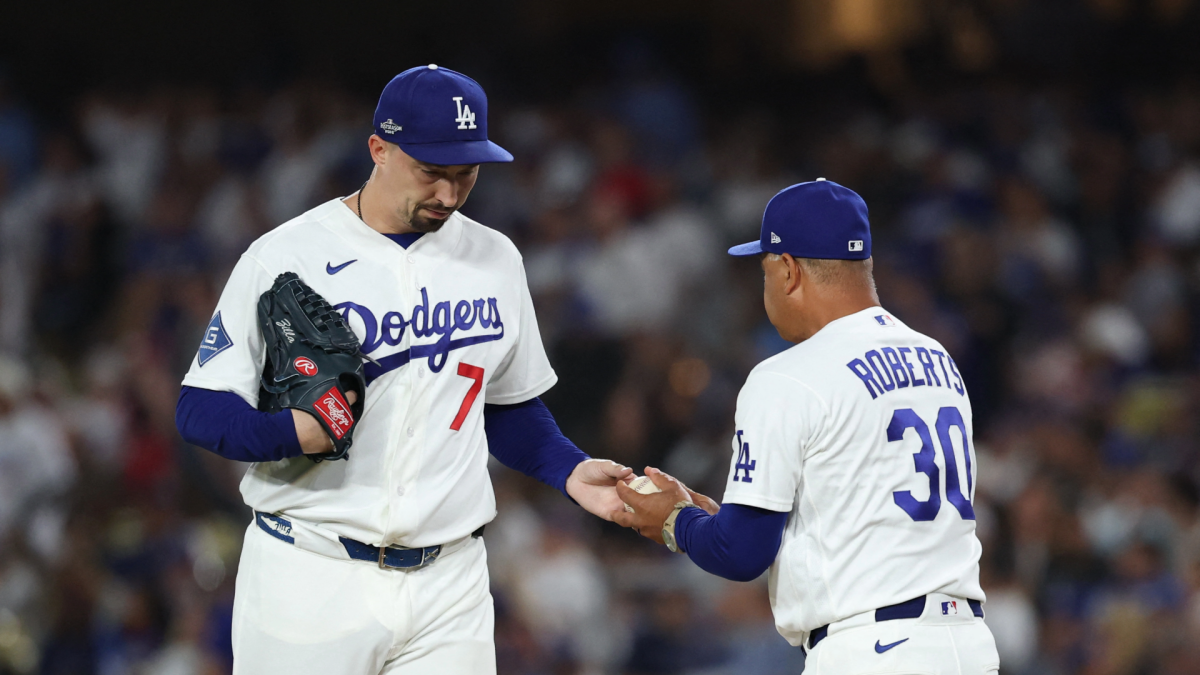
After going six innings in Game 3 of the NLCS on Wednesday, Los Angeles Dodgers lefty Blake Snell had his work cut out for him. After allowing a first-pitch home run in the first inning of the game, Snell settled in and allowed just one run in a nine-hit, one-walk performance with a squeaky fastball in front of his abundant second baseman. Manager Dave Roberts decided to let Snell come out for the seventh inning, which proved to be the decisive decision. eventually losing to the Milwaukee Brewers 6-2 that brought the Dodgers to the brink of extinction.
Snell entered the seventh inning facing 21 batters, which put him in a dangerous third in the order. The Brewers’ four-five-six inning, right-handed hitter Andrew Vaughn, was to lead off. Snell walked him on seven pitches. Then Jake Bauers came in and Roberts released Snell to face lefties. On the 11th and final pitch of the at-bat marathon, Bowers turned the game on its ear:
Snell’s night wasn’t over, even after being worked for 18 pitches by the previous two hitters. Another lefty, Garrett Mitchell, ignored the platoon deficit and turned it into back-to-back homers off the hard-working Snell:
It was the first time in Snell’s career that he allowed back-to-back home runs to left-handed hitters. Given the hitless Dodgers offensive attack, those two homers all but ended the game and the series. That put Roberts’ decision to push his chances with Snell under the microscope.
“I saw it after the sixth inning and then when we got to the seventh inning I think he retired 13 or 14 in a row and his stuff was really good,” Roberts said after the game of his decision to stick with Snell. “I don’t think they got a good look at him. I was trying to get him three more. We had Evan (Phillips) for the fourth inning. He split with those two lefties and took care of Vaughn.
“Obviously, the leadoff walk hurt. He didn’t give up a homer all year, but that’s just — that’s baseball. For me, I felt good about where Blake’s stuff was. You’ve got to give Bowers credit. He pitched another good inning, got them going and sparked that rally, and then saw eight innings.”
When Bowers decided to stick with Snell after the home run, Roberts said:
“Bauers is an at-bat, middle of the at-bat, so he’s going to finish the at-bat. Then he gives up a homer, and you’re out. I just don’t think it’s a good idea for me to let Mitchell get past where he’s throwing the baseball, the pitch count, all of that stuff, I think he threw well –“
Snell hadn’t really allowed a home run all season until Game 3. Although, that season was far from a full competition due to shoulder and elbow problems.
He also didn’t allow a home run in his NLDS start against the Braves. However, it was never going to last, especially with a pitcher like Snell with no record propensity. The slump in home runs allowed was always coming for him, and it came at the wrong time in Game 3. What made it all possible was Roberts’ decision to let Snell sit on the court longer than he should have.