Here at The Mag, we’ve invited a number of regular/irregular contributors to introduce us to their Newcastle United heroes and villains.
Thanks to Matt Busby Joe Harvey for accepting the challenge.
He looked back at the heroes and villains of Newcastle United during his various decades supporting NUFC.
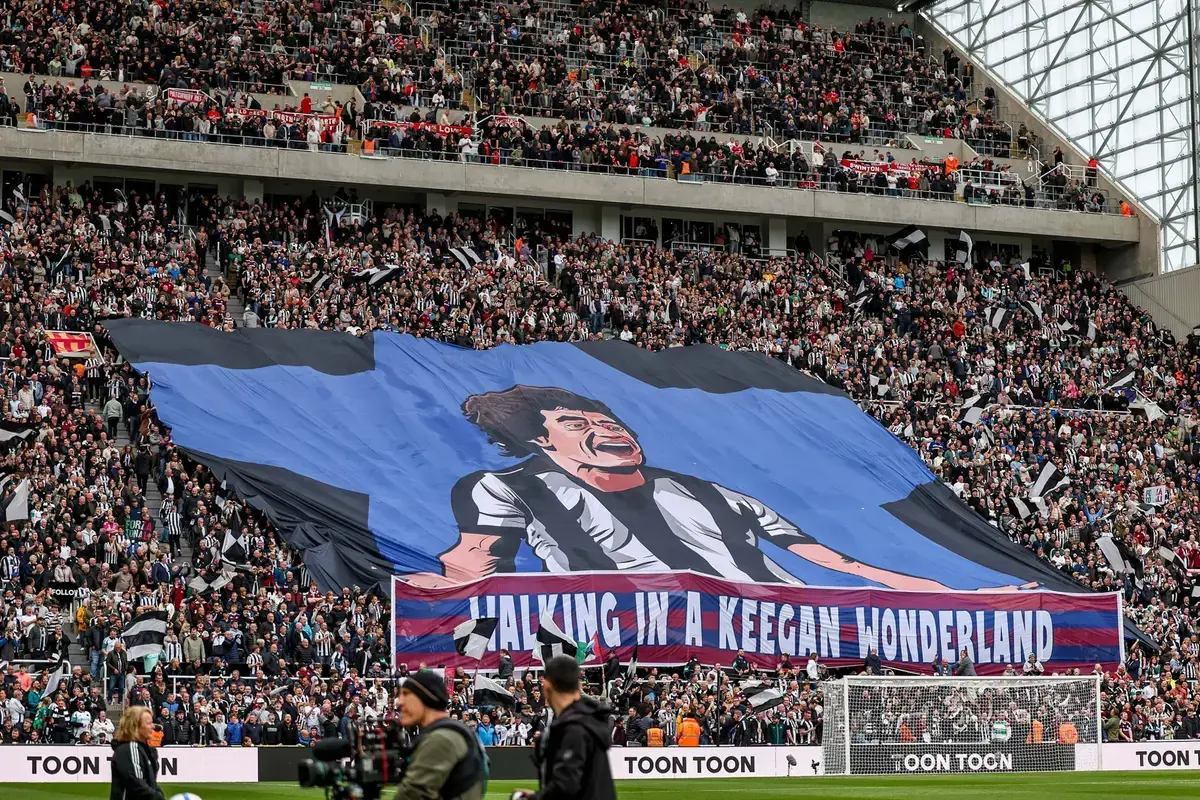
My hero of the 1980s was undoubtedly King Kev, the great man who sadly passed away in the summer, the floral carpet laid out in tribute outside St James’ Park and then the display of Wor Flags before the Liverpool game.
Of course, Kevin Keegan also managed Newcastle United not once but twice in the following decades, but his two years in black and white stripes between 1982 and 1984 left an indelible mark on everyone who witnessed that incredibly special period. I’ve never seen anything like the scenes in and around St James’ Park when Keegan scored on his debut against QPR and before he left us in May 1984, lifting us to third place from the old Second Division and before the need for a play-off. The trips to Maine Road, Ewood Park and Leeds Road on this incredible run will stay with me forever.
As for my villain from that decade, it would have to be Gordon McCague.
A club director, McKeag became chairman in 1988 and presided over a miserable relegation, St. James Park, however, later suffered from undercrowding and a serious lack of modernisation.
To the fans, McKeag was the face of a decrepit board that refused to invest in the first team, and with chants of “Sack the Board” the atmosphere at home matches grew increasingly hostile. McKeag’s narrative as a villain was reinforced by the arrival of Sir John Hall and the Magpie Group, with McKeag using his legal expertise to try and block Hall. Most fans resented this stubborn resistance by McKeag and his assistants, who were seen as emblematic of an archaic football oligarchy.
© 1988 The Mag. All rights reserved.
As for a cult hero of the 1980s…
When I began attending Newcastle United matches regularly in the 1980s, Tyneside was mired in industrial decline, the football club was mired in a seemingly endless series of crises and the terraces at St James’ Park were a radically different, more volatile environment to the stadium we know today.
It was against this background that a quiet piece of history was filmed in 1985.
When Tony Cunningham signed on the dotted line for Newcastle United in February 1985, he wasn’t just inheriting a shirt. Taking to the snow-covered pitch against Man U for his debut, the Jamaican-born striker became the first black player in United’s history to sign a permanent contract.
Big Tony’s time on Tyneside has to be seen in the context of the ugly reality of the era.
In the 1980s, football suffered from systemic racism and St James’ Park was no exception. Unfortunately, I still remember copies of the National Front edition, Bulldog being sold off the ground. And like all black players of the era, Cunningham had to endure as much prejudice from his own fans as abuse from fans of opposing teams.
It was Jack Charlton who signed the 6ft 2in frontman from Manchester City.
Big Jack wanted a physical, uncompromising target man, and what he got in Cunningham was someone who perhaps did more to get others into the game than steal the limelight.
I think judging Cunningham by his goal return alone (6 goals in 51 games) makes my point. He was a battering ram. He chased lost causes, put his head where the boots fly and gave absolutely everything for the black and white stripes.
On a sunny day in Nottingham in May 1987, hundreds of Newcastle United fans poured onto the pitch to celebrate a successful battle against relegation as the players walked off the pitch at the City Ground after yet another defeat in the season finale. One of the pitches was yours truly, and amidst the chaotic scenes, I asked big Tony for his shirt. Needless to say, I didn’t return to Tyneside with the intended souvenir, but I will say that the great Tony was a cult hero of the eighties nonetheless.
Shortly after securing a season in the top flight, Newcastle United parted ways with Cunningham in July 1987 when he was sold to third division side Blackpool for £25,000.
We all know that the fates often conspire in football circles and just a few months after the Nottingham trip myself and some mates were following Tony Cunningham to the same seaside resort as Newcastle United played Blackpool in the second round of the League Cup, the first leg at Bloomfield Road.
It was the evening of September 23, 1987, and the trip was spectacular.
The Housemartins’ second album, ‘People Who Smiled to Death’, had just been released and it was the soundtrack to the Pennine Isles. The combination of heavy drinking and some recreational drug use, alcohol and magic mushrooms by many travelers does not mix well with the attractions on offer at the Pleasure Beach. This being the late 1980s, it was inevitably followed by an argument outside the ground, although it was with a group of Geordies twice our age, a case of mistaken identity.
That night, big Tony turned villain on Bloomfield Road.
On the stroke of half-time, a misplaced pass from none other than Paul Gascoigne blundered Cunningham clear. Our former pioneer took full advantage of Gazza’s mistake and delivered the ball into his own goal to give Blackpool a 1-0 victory.
To add insult to injury, some of the kids were still stumbling around after the game, and after our driver refused to hang up, he went AWOL, needing to find alternative arrangements to get home.
In the second leg at St James’ Park, Blackpool scored early to take a 2-0 lead on aggregate, although goals from Paul Goddard, Mirandanha, Darren Jackson and Gazza made up for the mistake in the first leg.
Although Tony Cunningham was only on Tyneside for just over two years before moving to Blackpool, it would be fair to say that he laid the foundation for everything that followed to break down those hideous barriers that existed for black players at the time, and without the great Tony taking those early, heavy blows, I think the paths of superstars would have been similar to those of Could and Ferd in later years. infinitely more difficult.